
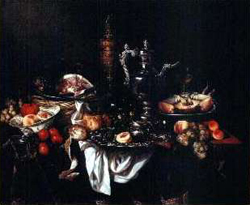
Abraham van Beyeren, Banquet still life (after 1655) coll. Mauritshuis

Harmen Steenwyck, An Allegory of the Vanities of Human Life (1640)
Karen Ingham: "I would like to hang a single drape of cloth from the hook in the centre of the Theatrum that will extend downwards to drape over a table in the centre of the space. The cloth is not only a reference to the Waag’s relationship to the cloth-makers guild, but is also a reference to the draped background in Dutch still life paintings. The draped table will be used as the surface for my still life reconstruction, based on the Vanitas of Dutch artists like Steenwyck and Van Beyeren.
The table will be set with a single vase of flowers in the centre.
This will be a large bouquet and the flowers used will have an association
with memory, for example Narcissi, Roses and Lobelia, and Tulips as
part of the cultural memory of the still life.
At the start of the installation the flowers will not have fully opened.
A specimen jar will be placed at either end of the table in proximity
to the bouquet. The jars will be labelled, one with the Latin inscription
for
the ‘Forget-me-not’ flower, Myosotis, and the other with the
inscription ars memoriae the art of memory. At the start of the installation
they will be empty. Sited above the Myosotis specimen jar, an identical
bunch of flowers will be hung, only this bunch will be inverted (the flowers
facing
downwards). The flowers will be fully opened and at their peak of perfection.
As the installation commences the suspended flowers will begin to drop their petals into the empty jar. The petals will continue to fall as the installation continues throughout the week. By the end of the residency the petals will have filled the jar, symbolising death and decay (the Waag’s history of anatomy and execution). But simultaneously, the flowers in the vase, which were closed at the start of the residency, will now have opened and will be at their most beautiful (a metaphor for new life and the Waag’s present links to creating communal art and memories)."