
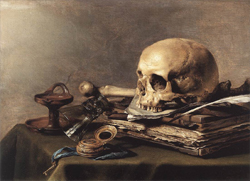
Karen Ingham Installation
18 - 22 April
From 18 - 22 April the Theatrum Anatomicum will host an installation by Karen Ingham, called Vanitas. If you would use Google's define:vanitas one of the results reads:
A painting (or element in painting) that acts as a reminder of the inevitability of death, and the pointlessness of earthly ambitions and achievements. Common vanitas-symbols include skulls, guttering candles, hour-glasses and clocks, overturned vessels, and even flowers (which will soon fade). The vanitas theme became popular during the Baroque, with the vanitas still life flourishing in Dutch art.
Karen Ingham: "Vanitas is a site-specific networked installation for
the Waag that draws on the buildings rich history and also references the
new media work of the Waag Society. Following my visit to the Waag in December,
I was impressed by the buildings historical links with not only anatomy (particularly
with the work of Ruysch) but also the fact that the building was used as
a site of execution. Death is inscribed in the very fabric of the Waag. But
life is also present in the buildings relationship to the various guilds,
and in its historical (and present) proximity to a flower market.
Ruysch is renowned for his incredible anatomical specimens, and flowers and bulbs
are also referred to as ‘specimens’ (the Tulip being the obvious ‘specimen’ of
choice in Amsterdam’s long cultural history). The anatomical or botanical
specimen is an object that defies time, something to be collected, classified,
and preserved. Many of Ruyschs’s most famous specimens consist of the heads
of stillborn infants (such as the poignant head of the female infant in the lace
collar at the recent Universiteit van Amsterdam exhibition), and in portraits
of Ruysch he is often seen holding a skull.
The head is not only the seat of learning but the brain is where memories are
created, stored and retrieved. Flowers also have a strong historical and pharmaceutical
relationship to memory, and the new media work of the Waag society is very much
concerned with creating new techno-neural networks of communal memory. The Waag
has become a site inscribed by ghosts and virtual presences, by historical memories
now communicated to the public not through the static collections of the Historisch
Museum (another aspect of Waag’s complex evolution) but through the 21st
centuries mediated metaphor of memory the web.
I would like to weave together these inter-linked aspects of the Waag by creating a ‘live-streamed’ Vanitas ‘still life’. The still life genre originated in the Nederlands, (particularly Amsterdam and Utrecht), and the Vanitas still life, with its emphasis on the all to swift passage of time and the impermanence of the human condition, was symbolised through the use of skulls and flowers; an allegory of death and mutability."